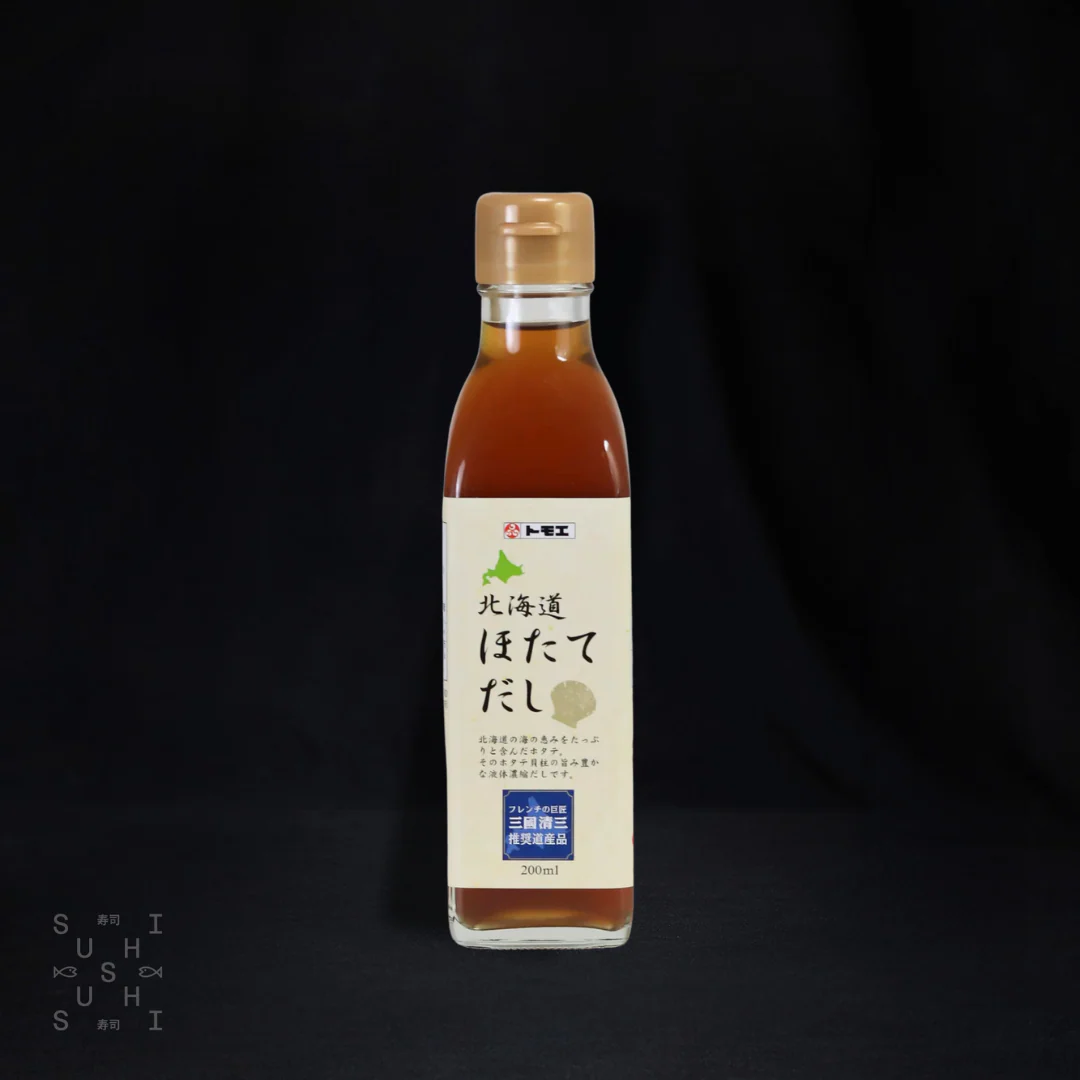
Tomoe, Hokkaido Scallop Dashi, 200ml
Television chef James Martin has long had this on his shelves, and it is easy to see why. Tomoe's Hokkaido Scallop Dashi is a concentrated liquid stock made from the scallops of Japan's northernmost island — Hokkaido, which supplies roughly ninety percent of Japan's annual scallop catch from its cold, nutrient-rich coastal waters. The result is a clean, savoury base with the characteristic sweetness of high-quality hotate: oceanic without being briny, rich without being heavy. For professional kitchens, the 200ml bottle is a precision ingredient — a controlled dose of scallop umami that builds a broth, deepens a sauce, or transforms a risotto in thirty seconds.
Why Chefs Choose This
- Concentrated Hokkaido scallop stock — a single splash delivers the sweetness and umami depth of high-quality hotate without the labour of extracting it from scratch
- Bridges Japanese and European technique — stirs directly into velouté, cream sauce, or risotto base without any flavour clash; James Martin's kitchen is not a Japanese restaurant
- Ready to use — no dilution ratio to manage; add incrementally to broth, sauce, or braising liquid and taste as you go
- Shelf-stable 200ml bottle — precision portioning without waste; the format suits à la carte service where a full dashi prep would be impractical
How to Use
- Broth base: dilute with hot water for a refined scallop soup or ramen broth — the sweetness of Hokkaido hotate carries clearly through the liquid
- Sauce and velouté: stir into a butter or cream sauce for fish, shellfish, or white meat; the scallop sweetness rounds the acidity without masking it
- Risotto: add to the ladling stock during cooking for a seafood risotto that tastes of something specific, not generic fish stock
- Marinade and dressing: a small measure added to a soy-citrus dressing creates layered umami without a single identifiable ingredient
Hotate (帆立) is the Japanese word for scallop: 帆 means sail and 立 means to stand — a reference to the bivalve's habit of opening its shell like a sail when filter-feeding. Hokkaido's scallop industry is centred on the Sea of Okhotsk and the northern Pacific, where cold water temperatures slow the growth of the hotate-gai and concentrate their flavour. The result is a sweetness distinct from warmer-water scallops. Tomoe's dashi process extracts that character and stabilises it in concentrated liquid form: glutamates from the scallop muscle combine with the natural sweetness of the adductor to produce a stock that reads as both savoury and delicate. The 帆立だし (hotate dashi) format is a professional shorthand for scallop essence — a stock that Japanese kitchens have made for centuries, now accessible without the lead time.
What does Hokkaido scallop dashi taste like compared to kombu or chicken stock?
Hokkaido scallop dashi is sweeter and lighter than either. Kombu dashi is purely glutamate-driven — savoury, mineral, and clean but without sweetness. Chicken stock has body and fat. Scallop dashi sits between the two: the umami of a seafood broth with a clean, sweet finish that doesn't linger. It doesn't dominate sauces the way fish stock can, which is why it works in cream and butter preparations where fish stock would overwhelm.
| Product | Tomoe Hokkaido Scallop Dashi |
| Volume | 200ml |
| Origin | Hokkaido, Japan |
| Brand | Tomoe |
| Primary use | Broth, sauce, risotto, marinade |
| Storage | Refrigerate after opening |
| SKU | S0397 |
Is this ready to use or does it need diluting?
It is a concentrated stock, not a seasoning, so the best approach is to taste as you add. For a clear broth or soup, dilute to taste with hot water — start with a 1:4 ratio and adjust. For sauces and risotto, add it in small measures to the base and build from there. It doesn't need diluting before use; add it directly and let your palate guide the quantity.
Why Hokkaido specifically?
Hokkaido is Japan's principal scallop-producing region, accounting for the majority of national output. The cold waters of the Sea of Okhotsk and the northern Pacific slow growth, which concentrates the natural sugars and umami compounds in the scallop muscle. Hokkaido hotate are the benchmark for Japanese scallop quality — cleaner, sweeter, and more distinctly flavoured than warmer-water equivalents. That character is what the dashi captures.
Can it be used in non-Japanese dishes?
Yes — that is largely how it is used in European professional kitchens. The flavour profile (sweet, savoury, clean) translates naturally into French and Italian technique. It works in velouté, cream sauces, butter-mounted pan sauces, risotto, and pasta water. The scallop sweetness doesn't announce itself as Japanese; it registers as depth. James Martin doesn't run a Japanese restaurant and neither do most of the UK chefs who stock it.
Original: $28.15
-65%$28.15
$9.85Tomoe, Hokkaido Scallop Dashi, 200ml
Television chef James Martin has long had this on his shelves, and it is easy to see why. Tomoe's Hokkaido Scallop Dashi is a concentrated liquid stock made from the scallops of Japan's northernmost island — Hokkaido, which supplies roughly ninety percent of Japan's annual scallop catch from its cold, nutrient-rich coastal waters. The result is a clean, savoury base with the characteristic sweetness of high-quality hotate: oceanic without being briny, rich without being heavy. For professional kitchens, the 200ml bottle is a precision ingredient — a controlled dose of scallop umami that builds a broth, deepens a sauce, or transforms a risotto in thirty seconds.
Why Chefs Choose This
- Concentrated Hokkaido scallop stock — a single splash delivers the sweetness and umami depth of high-quality hotate without the labour of extracting it from scratch
- Bridges Japanese and European technique — stirs directly into velouté, cream sauce, or risotto base without any flavour clash; James Martin's kitchen is not a Japanese restaurant
- Ready to use — no dilution ratio to manage; add incrementally to broth, sauce, or braising liquid and taste as you go
- Shelf-stable 200ml bottle — precision portioning without waste; the format suits à la carte service where a full dashi prep would be impractical
How to Use
- Broth base: dilute with hot water for a refined scallop soup or ramen broth — the sweetness of Hokkaido hotate carries clearly through the liquid
- Sauce and velouté: stir into a butter or cream sauce for fish, shellfish, or white meat; the scallop sweetness rounds the acidity without masking it
- Risotto: add to the ladling stock during cooking for a seafood risotto that tastes of something specific, not generic fish stock
- Marinade and dressing: a small measure added to a soy-citrus dressing creates layered umami without a single identifiable ingredient
Hotate (帆立) is the Japanese word for scallop: 帆 means sail and 立 means to stand — a reference to the bivalve's habit of opening its shell like a sail when filter-feeding. Hokkaido's scallop industry is centred on the Sea of Okhotsk and the northern Pacific, where cold water temperatures slow the growth of the hotate-gai and concentrate their flavour. The result is a sweetness distinct from warmer-water scallops. Tomoe's dashi process extracts that character and stabilises it in concentrated liquid form: glutamates from the scallop muscle combine with the natural sweetness of the adductor to produce a stock that reads as both savoury and delicate. The 帆立だし (hotate dashi) format is a professional shorthand for scallop essence — a stock that Japanese kitchens have made for centuries, now accessible without the lead time.
What does Hokkaido scallop dashi taste like compared to kombu or chicken stock?
Hokkaido scallop dashi is sweeter and lighter than either. Kombu dashi is purely glutamate-driven — savoury, mineral, and clean but without sweetness. Chicken stock has body and fat. Scallop dashi sits between the two: the umami of a seafood broth with a clean, sweet finish that doesn't linger. It doesn't dominate sauces the way fish stock can, which is why it works in cream and butter preparations where fish stock would overwhelm.
| Product | Tomoe Hokkaido Scallop Dashi |
| Volume | 200ml |
| Origin | Hokkaido, Japan |
| Brand | Tomoe |
| Primary use | Broth, sauce, risotto, marinade |
| Storage | Refrigerate after opening |
| SKU | S0397 |
Is this ready to use or does it need diluting?
It is a concentrated stock, not a seasoning, so the best approach is to taste as you add. For a clear broth or soup, dilute to taste with hot water — start with a 1:4 ratio and adjust. For sauces and risotto, add it in small measures to the base and build from there. It doesn't need diluting before use; add it directly and let your palate guide the quantity.
Why Hokkaido specifically?
Hokkaido is Japan's principal scallop-producing region, accounting for the majority of national output. The cold waters of the Sea of Okhotsk and the northern Pacific slow growth, which concentrates the natural sugars and umami compounds in the scallop muscle. Hokkaido hotate are the benchmark for Japanese scallop quality — cleaner, sweeter, and more distinctly flavoured than warmer-water equivalents. That character is what the dashi captures.
Can it be used in non-Japanese dishes?
Yes — that is largely how it is used in European professional kitchens. The flavour profile (sweet, savoury, clean) translates naturally into French and Italian technique. It works in velouté, cream sauces, butter-mounted pan sauces, risotto, and pasta water. The scallop sweetness doesn't announce itself as Japanese; it registers as depth. James Martin doesn't run a Japanese restaurant and neither do most of the UK chefs who stock it.
Product Information
Product Information
Shipping & Returns
Shipping & Returns
Description
Television chef James Martin has long had this on his shelves, and it is easy to see why. Tomoe's Hokkaido Scallop Dashi is a concentrated liquid stock made from the scallops of Japan's northernmost island — Hokkaido, which supplies roughly ninety percent of Japan's annual scallop catch from its cold, nutrient-rich coastal waters. The result is a clean, savoury base with the characteristic sweetness of high-quality hotate: oceanic without being briny, rich without being heavy. For professional kitchens, the 200ml bottle is a precision ingredient — a controlled dose of scallop umami that builds a broth, deepens a sauce, or transforms a risotto in thirty seconds.
Why Chefs Choose This
- Concentrated Hokkaido scallop stock — a single splash delivers the sweetness and umami depth of high-quality hotate without the labour of extracting it from scratch
- Bridges Japanese and European technique — stirs directly into velouté, cream sauce, or risotto base without any flavour clash; James Martin's kitchen is not a Japanese restaurant
- Ready to use — no dilution ratio to manage; add incrementally to broth, sauce, or braising liquid and taste as you go
- Shelf-stable 200ml bottle — precision portioning without waste; the format suits à la carte service where a full dashi prep would be impractical
How to Use
- Broth base: dilute with hot water for a refined scallop soup or ramen broth — the sweetness of Hokkaido hotate carries clearly through the liquid
- Sauce and velouté: stir into a butter or cream sauce for fish, shellfish, or white meat; the scallop sweetness rounds the acidity without masking it
- Risotto: add to the ladling stock during cooking for a seafood risotto that tastes of something specific, not generic fish stock
- Marinade and dressing: a small measure added to a soy-citrus dressing creates layered umami without a single identifiable ingredient
Hotate (帆立) is the Japanese word for scallop: 帆 means sail and 立 means to stand — a reference to the bivalve's habit of opening its shell like a sail when filter-feeding. Hokkaido's scallop industry is centred on the Sea of Okhotsk and the northern Pacific, where cold water temperatures slow the growth of the hotate-gai and concentrate their flavour. The result is a sweetness distinct from warmer-water scallops. Tomoe's dashi process extracts that character and stabilises it in concentrated liquid form: glutamates from the scallop muscle combine with the natural sweetness of the adductor to produce a stock that reads as both savoury and delicate. The 帆立だし (hotate dashi) format is a professional shorthand for scallop essence — a stock that Japanese kitchens have made for centuries, now accessible without the lead time.
What does Hokkaido scallop dashi taste like compared to kombu or chicken stock?
Hokkaido scallop dashi is sweeter and lighter than either. Kombu dashi is purely glutamate-driven — savoury, mineral, and clean but without sweetness. Chicken stock has body and fat. Scallop dashi sits between the two: the umami of a seafood broth with a clean, sweet finish that doesn't linger. It doesn't dominate sauces the way fish stock can, which is why it works in cream and butter preparations where fish stock would overwhelm.
| Product | Tomoe Hokkaido Scallop Dashi |
| Volume | 200ml |
| Origin | Hokkaido, Japan |
| Brand | Tomoe |
| Primary use | Broth, sauce, risotto, marinade |
| Storage | Refrigerate after opening |
| SKU | S0397 |
Is this ready to use or does it need diluting?
It is a concentrated stock, not a seasoning, so the best approach is to taste as you add. For a clear broth or soup, dilute to taste with hot water — start with a 1:4 ratio and adjust. For sauces and risotto, add it in small measures to the base and build from there. It doesn't need diluting before use; add it directly and let your palate guide the quantity.
Why Hokkaido specifically?
Hokkaido is Japan's principal scallop-producing region, accounting for the majority of national output. The cold waters of the Sea of Okhotsk and the northern Pacific slow growth, which concentrates the natural sugars and umami compounds in the scallop muscle. Hokkaido hotate are the benchmark for Japanese scallop quality — cleaner, sweeter, and more distinctly flavoured than warmer-water equivalents. That character is what the dashi captures.
Can it be used in non-Japanese dishes?
Yes — that is largely how it is used in European professional kitchens. The flavour profile (sweet, savoury, clean) translates naturally into French and Italian technique. It works in velouté, cream sauces, butter-mounted pan sauces, risotto, and pasta water. The scallop sweetness doesn't announce itself as Japanese; it registers as depth. James Martin doesn't run a Japanese restaurant and neither do most of the UK chefs who stock it.